Showing posts with label Reformed. Show all posts

Thursday, February 2, 2012

What Kind Of Pastors Do Sinners Need?

Here is a blog post from Tullian Tchividjian's blog in which he quotes Sinclair Ferguson. This was brought to my attention by Danny Hindman.

What kind of pastor do sinners need?
 
Sinclair Ferguson answers this question from his Marrow Controversy Lectures:
But when your people come and have been broken by sin and have fallen into temptation and are ashamed to confess the awful mess they have made of their life, it is not a Calvinistic pastor who has been sanctified by vinegar that they need. It is a pastor that has been mastered by the unconditional, free grace of God. It is a pastor from whom ironclad orthodoxy has been torn away and the whole armor of a gracious God has been placed upon his soul–the armor of one who would not break the bruised reed or quench the dimly burning wick.
You see, my friends, as we think together in these days about a Godly pastor we have to ask, what is a Godly pastor? A Godly pastor is one who is like God, who has a heart of free grace running after sinners. The Godly pastor is the one who sees the prodigal and runs and falls on his neck and weeps and kisses him and says, “This my son was dead, he was lost and now he is alive and found.”
Pastors, when sinners are drowning, don’t tell them to paddle harder and kick faster. Throw them the life-line of amazing grace.

Friday, July 8, 2011

Grace More Abundant

"My sins are more than the wide sea's sand, but where sin abounds, there is grace more abundant. Look to the cross of thy beloved Son, and view the preciousness of his atoning blood; Listen to his never-failing intercession, and whisper to my heart, 'Thy sins are forgiven, be of good cheer, lie down in peace'."

- Valley of Vision, The Prayer of Love

Thursday, June 16, 2011

Good Discussion

Per Kevin DeYoung's blog on the TGC website and Tullian Tchividjian's blog on the TGC website. This are a couple of articles in a very insightful discussion by guys that are much smarter than I am, and guys who love Jesus. I love discussion and learning. Each of these articles has caused me to think about the two wonderful doctrines of justification and sanctification, and of God's incredible grace toward sinners!

Monday, April 25, 2011

Daily Wisdom

"Teach me the happy art of attending to things temporal with a mind intent on things eternal."

- Valley of Vision, Christlikeness

....

Mike, I throw this up here knowing I very often am consumed in my work, and the tasks of the day. More so, my self-centeredness distracts me from the TRUE END of these very tasks, which I pray to be Christ. Since daily tasks are inevitable and necessary, may we encourage one another to recall when we are amidst the daily grind, the person whom gives meaning to everything in our lives, the person of Christ.

Monday, March 28, 2011

Is It Time to Write the Eulogy for Seminary Education?


A very thoughtful article from Don Sweeting, the president from Reformed Theological Seminary, Orlando.
Frederick Schmidt wrote a recent article wondering about the future of seminary education, entitled, Is It Time to Write the Eulogy?: The Future of Seminary Education.  The article begins by saying, “our seminaries are dying and the Master of Divinity degree has been discredited.”  Schmidt writes about a shrinking pool of prospective students, and notes that a large number of “mainline seminaries” are selling their buildings, property, cutting faculty and eliminating programs.
And there, my friends, is the give-away.  Schmidt, who writes a column for what the Patheos website still refers to as “mainline Protestants,” is describing a mainline that is no longer the main line.  It is fast declining, and so are its seminaries.
According to Rodney Stark, one of America’s preeminent scholars of religion, it is time to redefine our terms.  Stark is quite forthright in saying that the true mainline Protestants in America are now evangelicals.   And the old mainline is, in his words, the “sideline.”  
In other words, it may be time to consider writing a eulogy for mainline seminary education, but it is not for evangelical seminary education.   Among ATS schools, evangelical schools are proliferating and their numbers remain strong.  
Stark and others note the “evangelicalization of Protestantism.”  The churches that are growing, he says, have evangelical clergy. Not only that, but he ties the decline in numbers in the old mainline churches with what is happening theologically in the seminaries.   As denominations get liberal, says Stark, they shrink.   Liberal clergy lose their faith. They no longer believe in the Bible as God’s Word.   Or they disbelieve in the divinity of Jesus Christ.  Or they decide that they are no longer in the business of saving souls.  Instead, their preoccupation becomes left wing radical politics.   Stark lays the blame for this decline of the old mainline at the doorstep of the liberal seminaries. (Seehttp://www.patheos.com/Resources/Additional-Resources/Are-Evangelicals-the-New-Mainline?offset=2&max=1&showAll=1). 
All of this interests me because I am now the president of a reformed, evangelical seminary (RTS Orlando http://www.rts.edu/orlando/ ).  And from what I see, business is ramping up and seminary education (at the right schools) is more important than ever.  By the way, by “right schools,” I mean seminaries that hold on to basic Christian orthodoxy.  That is, they believe in the truthfulness and supreme authority of the Bible.  They believe in the gospel of Jesus with a passion, and find an urgency to share it because people’s souls hang in the balance.
Once a seminary abandons its belief in the supreme authority of the Bible, they set their theological soul adrift.   Eventually they let go of orthodoxy and redefine the gospel.  Something else besides the real incarnation, atoning cross and bodily resurrection of Jesus becomes the center.
Here’s why this seminary eulogy does not apply to a seminary like RTS.   And here’s why seminary education at the right schools is more important than ever:
1          The gospel is “the power of God for the salvation of everyone who believes:  first for the Jew, then for the Gentile. For in the gospel a righteousness from God is revealed, a righteousness that is by faith from first to last.” (Romans 1.16,17)   This gospel was and is the best news on earth.  
2          The knowledge of God is the most important knowledge in the world.   It was A. W. Tozer who wrote in the chapter, “Why We Must Think Rightly About God,” from his book Knowledge of the Holy:  “What comes into our minds when we think about God is the most important thing about us. The history of mankind will probably show that no people has ever risen above its religion, and man’s spiritual history will positively demonstrate that no religion has ever been greater than its ideas of God.” Hence the need to give people a true knowledge of God.
3          Seminaries rooted in the Word train men and women in Biblical wisdom like no other institution.  That is what makes us unique.  This wisdom is exceedingly important for the church, and for civilization.  The core belief driving this is that in Christ “are hidden all the treasures of wisdom and knowledge.” (Colossians 2.3). 
4          Related to this, seminaries train students to study the Word and know the Word in the original languages.   They train students in Christian spiritual formation.   Along with this, they train in subjects related to living a God-glorifying life—subjects like biblical and systematic theology, Christian ethics, church history, practical theology, preaching, teaching, worship, prayer, Christian leadership, missions, evangelism, pastoring, apologetics, etc..
5          Preparation for faithful, competent and creative Christian ministry is more important than ever.   We live in a complex, fast changing world.  The spiritual battles are hotter, and the stakes seem higher than ever.   So when it comes to training for ministry leadership and soul care, we must encourage the very best training possible.   We demand it of our doctors and our engineers.  Can we demand less of our pastors and spiritual leaders?   That’s why good, quality seminary training is so critical.  And that is why quick fix training, through  easy degree diploma mills, undermines the ministry of the church.  To be a spiritual force in the twenty-first century, our leaders need the best and most thorough training possible.
6          Seminaries play a strategic role in the life of the church and nation.   We desperately need strong and healthy churches.   Healthy churches bring Christ’s redemptive hope to our communities.  As our communities are transformed, so goes our nation.   Churches generally do not rise above the spiritual level of their pastors.   And the seminary is the critical institution for training pastors.   Pastors are either made or marred in the seminary. 
Sharing this news story about “the dying seminaries” with a businessman friend over lunch today, he said “Don, quite frankly, some seminaries deserve to die.”   He explained, if they have abandoned the Biblical gospel and the Holy Scriptures, they have lost their reason for existing.   But if they hang on to that Word which abides forever, they are desperately important.
I couldn’t agree more.

Saturday, January 22, 2011

Saying What You Believe is Clearer Than Saying "Calvinist"

Per John Piper, The Gospel Coalition

"We are Christians. Radical, full-blooded, Bible-saturated, Christ-exalting, God-centered, mission-advancing, soul-winning, church-loving, holiness-pursing, sovereignty-savoring, grace-besotted, broken-hearted, happy followers of the omnipotent, crucified Christ. At least that’s our imperfect commitment.

In other words, we are Calvinists. But that label is not nearly as useful as telling people what you actually believe! So forget the label, if it helps, and tell them clearly, without evasion or ambiguity, what you believe about salvation.

If they say, “Are you a Calvinist?” say, “You decide. Here is what I believe . . .”

I believe I am so spiritually corrupt and prideful and rebellious that I would never have come to faith in Jesus without God’s merciful, sovereign victory over the last vestiges of my rebellion. (1 Corinthians 2:14; Ephesians 3:1–4; Romans 8:7).

I believe that God chose me to be his child before the foundation of the world, on the basis of nothing in me, foreknown or otherwise. (Ephesians 1:4–6; Acts 13:48; Romans 8:29–30; 11:5–7)

I believe Christ died as a substitute for sinners to provide a bona fide offer of salvation to all people, and that he had an invincible design in his death to obtain his chosen bride, namely, the assembly of all believers, whose names were eternally written in the book of life of the Lamb that was slain. (John 3:16; John 10:15; Ephesians 5:25; Revelation 13:8)

When I was dead in my trespasses, and blind to the beauty of Christ, God made me alive, opened the eyes of my heart, granted me to believe, and united me to Jesus, with all the benefits of forgiveness and justification and eternal life. (Ephesians 2:4–5; 2 Corinthians 4:6; Philippians 2:29; Ephesians 2:8–9; Acts 16:14; Ephesians 1:7; Philippians 3:9)

I am eternally secure not mainly because of anything I did in the past, but decisively because God is faithful to complete the work he began—to sustain my faith, and to keep me from apostasy, and to hold me back from sin that leads to death. (1 Corinthians 1:8–9; 1 Thessalonians 5:23–24; Philippians 1:6; 1 Peter 1:5; Jude 1:25; John 10:28–29; 1 John 5:16)

Call it what you will, this is my life. I believe it because I see it in the Bible. And because I have experienced it. Everlasting praise to the greatness of the glory of the grace of God!"

Thursday, December 23, 2010

The heart of 'Calvinism'

Just started reading a book entitled, 'Letters to a Young Calvinist'. The book is a series of hypothetical pastoral letters from the author to a young man, "Jesse", who has just come into the reformed faith. The author, James K. A. Smith, helps navigate Jesse through the depths and perils of the reformed faith. He answers Jesse's questions and offers him both Biblical and experiential advice.

An obvious reason why I have enjoyed the book so far is its contextual relevance to my life. This book speaks directly to those in the 'new calvinism' movement. More so, I have enjoyed the book because of the pastoral wisdom that James Smith's provides. For example, Smith warns Jesse against the tendency of young calvinists to be arrogant and prideful in their doctrine. Rather, the reformed faith should breed a deep sense of humility. He also challenges Jesse to make God's grace the foundation of his faith. In summarizing the reformed faith, James Smith writes to Jesse,

"At its heart, Calvinism is simply a lens that magnifies a persistent theme in the narrative of God's self-revelation; that everything depends on God. Everything is a gift. This doesn't just apply to salvation-it's true of creation itself. God created the world out of- and for- his pleasure, as an act of love. There's no hint of necessity or requirement here: God could have not created the world. The world exists and is sustained only because of God's sovereign action; and creation is still radically dependent on God's gift of existence. So we might say, that grace goes 'all the way down'. To merely exist as a creature is to be dependent on the gift of existence granted by a gracious God; to be is to be graced."


Thursday, June 24, 2010

John Bunyan: Puritan Prisoner

Most well known for his literary classic Pilgrim's Progress, John Bunyan highlights for us the story of his conversion in another one of his works titled Grace Abounding to the Chief of Sinners, which he wrote while in prison...

"But one day as I was passing into the field, and that too with some dashes on my conscience, fearing lest yet all was not right suddenly this sentence fell upon my soul, Thy righteousness is in heaven; and methought withal, I saw with the eyes of my soul, Jesus Christ at God's right hand there, I say, was my righteousness so that wherever I was or whatever I was doing God could not say of me, He wants my righteousness, for that was just before him. I also saw, moreover, that it was not my good frame of heart that made my righteousness better, nor yet my bad frame that made my righteousness worse, for my righteousness was Jesus Christ himself, the same yesterday and to day and for ever (Heb xiii 8). Now did my chains fall off my legs indeed, I was loosened from my afflictions and irons, my temptations also fled away; so that, from that time, those dreadful scriptures of God left off to trouble me now; now went I also home rejoicing, for the grace and love of God.

....

His story makes me think of the fourth verse of the wonderful hymn And Can It Be That I Should Gain? by Charles Wesley...

Long my imprisoned spirit lay,
Fast bound in sin and nature’s night;
Thine eye diffused a quickening ray—
I woke, the dungeon flamed with light;
My chains fell off, my heart was free,
I rose, went forth, and followed Thee.
My chains fell off, my heart was free,
I rose, went forth, and followed Thee.

....

May we remember 'It is Finished'. As we are in Christ, we are clothed in His righteousness. I know I struggle in thinking I need to do better in effort to gain something of my own. It is a lie, and it is enslaving; and countless times it leaves me in a state of anxiety and restlessness. But I also know, I am freed from that bondage when I simply look to Jesus on the cross, because for me, He gained everything already.

Saturday, June 19, 2010

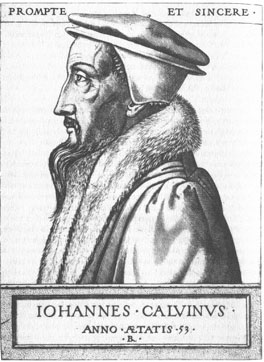
Calvin's Romantic Life


I came across this text as I am slowly making my way through Michael Reeves The Unquenchable Flame: Discovering the Heart of the Reformation.

....

"One cannot really speak of Calvin's romantic life. He was no Gallic paramour.

[John Calvin says,]

'As for marriage, I am not one of those infatuated lovers who, captivated by a pretty face, kiss even her vices. The only beauty which interests me is that she should be modest, obliging, not haughty, not extravagant, patient and solicitous for my health.'

Nevertheless, he was keen to express his Protestant approval of marriage, and 1540 in Strasbourg became a whirl of matchmaking as his friends tried to help him find such a girl."

....

Though I realize there is great wisdom to appreciate about his words, I also chuckle at the underlying humor Calvin inadvertently speaks with, because any kind of infiltration of the female kind into his life is probably the farthest thing from his mind...haha. I love it, and wish I was alive to hear it.

Tuesday, June 15, 2010

Luther's Gospel Revelations


The following three excerpts are beautiful gospel truths that were revealed to Martin Luther through the grace of Jesus Christ. They not only ended up rocking his theological universe, but also the rest of the world around 1500 AD. They are recorded in a wonderful historical and gospel-centered introduction to the Reformation in the book titled The Unquenchable Flame: Discovering the Heart of the Reformation by Michael Reeves...

"For some time, the answer eluded him. Then, in 1519, when he was looking again at the issues of confession and repentance, it struck him that, after the sinner had confessed, the priest would pronounce God's promise of forgiveness. It was a whole new way of looking at things for Luther: now, the question was, would the sinner trust God's promise? And with that, everything changed. Now he saw that forgiveness is not dependent on how certain the sinner is that he has been truly contrite; forgiveness comes simply be receiving the promise of God. Thus the sinner's hope is found, not in himself, but outside himself, in God's word of promise."

"Luther saw that the sinner, on accepting Christ's promise in the gospel, is simultaneously a sinner at heart and righteous by status. What has happened is the 'joyful exchange' in which all that she has (her sin) she gives to him, and all that he has (his righteousness, blessedness, life and glory) he gives to her. Thus she can confidently display 'her sins in the face of death and hell and say, "If I have sinned, yet my Christ, in whom I believe, has not sinned, and all his is mine and all mine is his".'"

"Faith, thought Luther, is not some inner resource we must summon up; if it were, it would by his definition be sin! For him, the question 'Have I got enough faith?' completely misunderstands what faith is, by looking to and so relying on itself, rather than Christ. Faith is a passive thing, simply accepting, receiving, believing Christ - taking God seriously in what he promises in the gospel."

Friday, June 11, 2010

Reformed Theology can become an Idol

I didn't know what "reformed" meant just a year ago. However, a lot can happen in a year. I now love reformed theology and reformed things in general. I believe the Holy Spirit has used the reformed theological disposition to magnify God, the cross and His Gospel in my life more than anything else. However, as Tim Keller, Senior Minister of Redeemer Presbyterian Church in New York City, has said, "any thing (including inherently good things) that becomes an ultimate thing has now become an idol."

The following excerpt comes from his book Counterfeit Gods. Along with his book titled Prodigal God, no two books have affected my heart and mind for the sake of gospel more so than these.

....

"An idol is something that we look to for things that only God can give. Idolatry functions widely inside religious communities when doctrinal truth is elevated to the position of a false God. This occurs when people rely on the rightness of their doctrine for their standing with God rather than on God himself and his grace. It is a subtle but deadly mistake."

....

It is really easy to get excited about Reformed (Calvinist) theology. To me, it illuminates the truth of the gospel in an unprecedented way. It is very, very awesome. However, I need to remember that Reformed theology is only a means to point to Jesus Christ as my Lord and Savior. In itself, being reformed is a good thing, but it is not an ultimate thing. Reformed theology is not saving. Being washed white as snow by the blood of Jesus on the cross is an ultimate thing...Being completely accepted by the King of the universe in my lowest, most disgusting state is an ultimate thing...Having daily peace in knowing I can't and don't have to merit God's favour out of my own doing because Christ already did it for me out of sweet mercy is an ultimate thing...In short, Jesus is the ultimate thing. His presence with us on this earth today and in heaven for eternity is an ultimate thing. And we can be grateful that there is nothing that can ever take that away from us.

Tuesday, June 8, 2010

We are One in Christ

The following text comes from Ray Ortlund's blog, Christ is Deeper Still, found on the Gospel Coalition website

....

#10: Truly Reformed

I believe in the sovereignty of God, the Five Points of Calvinism, the Solas of the Reformation, I believe that grace precedes faith in regeneration. Theologically, I am Reformed. Sociologically, I am simply a Christian – or at least I want to be. The tricky thing about our hearts is that they can turn even a good thing into an engine of oppression. It happens when our theological distinctives make us aloof from other Christians. That’s when, functionally, we relocate ourselves outside the gospel and inside Galatianism.

The Judaizers in Galatia did not see their distinctive – the rite of circumcision – as problematic. They could claim biblical authority for it in Genesis 17 and the Abrahamic covenant. But their distinctive functioned as an addition to the all-sufficiency of Jesus himself. Today the flash point is not circumcision. It can be Reformed theology. But no matter how well argued our position is biblically, if it functions in our hearts as an addition to Jesus, it ends up as a form of legalistic divisiveness.

Paul answered the theological aspects of the Galatian error with solid theology. But the “whiff test” that something was wrong in those Galatian churches was more subtle than theology alone. The problem was also sociological. “They make much of you, but for no good purpose. They want to shut you out, that you may make much of them” (Galatians 4:17). In other words, “The legalists want to ‘disciple’ you. But really, they’re manipulating you. By emphasizing their distinctive, they want you to feel excluded so that you will conform to them.” It’s like chapter two of Tom Sawyer. Remember how Tom got the other boys to whitewash the fence for him? Mark Twain explained: “In order to make a man or boy covet a thing, it is only necessary to make the thing difficult to attain.” Paul saw it happening in Galatia. But the gospel makes full inclusion in the church easy to attain. It re-sets everyone’s status in terms of God’s grace alone. God’s grace in Christ crucified, and nothing more. He alone makes us kosher. He himself.

The Judaizers would probably have answered at this point, “We love Jesus too. But how can you be a first-rate believer, really set apart to God, without circumcision, so plainly commanded right here in the Bible? This isn’t an add-on. It’s the full-meal deal. God says so.”

Their misuse of the Bible showed up in social dysfunction. “It is those who want to make a good showing in the flesh who would force you to be circumcised. . . . They desire to have you circumcised that they may boast in your flesh” (Galatians 6:12-13). In other words, “When Christians, whatever the label or badge or shibboleth, start pressuring you to come into line with their distinctive, you know something’s wrong. They want to enhance their own significance by your conformity to them: ‘See? We’re better. We’re superior. People are moving our way. They are becoming like us. We’re the buzz.’” What is this, but deep emotional emptiness medicating itself by relational manipulation? This is not about Christ. This is about Self. Even Peter fell into this hypocrisy (Galatians 2:11-14). But no matter who is involved, this is not the ministry of the gospel. Even if a biblical argument can be made for a certain position, and we all want to be biblical, the proof of what’s really happening is not in the theological argumentation but in the sociological integration.

Paul had thought it through. He made a decision that the bedrock of his emotional okayness would forever lie here: “Far be it from me to boast [establish my personal significance] except in the cross of our Lord Jesus Christ. . . . For neither circumcision counts for anything, nor uncircumcision, but a new creation” (Galatians 6:14-15). In other words, “Here is all I need for my deepest sense of myself: Jesus Christ crucified. His cross has deconstructed me and remade me, and I am happy. Everything else is at best secondary, possibly irrelevant, even counterproductive. Let Jesus alone stand forth in my theology, in my emotional well-being and in my relationships with other Christians!” This settledness in Paul’s heart made him a life-giving man for other people. He was a free man, setting others free (Galatians 5:1). This is the acid test of a truly Reformed ministry – that other believers need not be Reformed in order to be respected and included in our hearts.

Whatever divides us emotionally from other Bible-believing, Christ-honoring Christians is a “plus” we’re adding to the gospel. It is the Galatian impulse of self-exaltation. It can even become a club with which we bash other Christians, at least in our thoughts, to punish, to exclude and to force into line with us.

What unifies the church is the gospel. What defines the gospel is the Bible. What interprets the Bible correctly is a hermeneutic centered on Jesus Christ crucified, the all-sufficient Savior of sinners, who gives himself away on terms of radical grace to all alike. What proves that that gospel hermeneutic has captured our hearts is that we are not looking down on other believers but lifting them up, not seeing ourselves as better but grateful for their contribution to the cause, not standing aloof but embracing them freely, not wishing they would become like us but serving them in love (Galatians 5:13).

My Reformed friend, can you move among other Christian groups and really enjoy them? Do you admire them? Even if you disagree with them in some ways, do you learn from them? What is the emotional tilt of your heart – toward them or away from them? If your Reformed theology has morphed functionally into Galatian sociology, the remedy is not to abandon your Reformed theology. The remedy is to take your Reformed theology to a deeper level. Let it reduce you to Jesus only. Let it humble you. Let this gracious doctrine make you a fun person to be around. The proof that we are Reformed will be all the wonderful Christians we discover around us who are not Reformed. Amazing people. Heroic people. Blood-bought people. People with whom we are eternally one – in Christ alone.

....

I know I needed to hear this.