An incredible spoken word piece by Matt Papa. He does an excellent job of capturing the storyline of all human history and connecting it to this present moment. As he says, "it's a story like no other, it's a movement you can't undo."
Showing posts with label History. Show all posts
Showing posts with label History. Show all posts
Tuesday, December 11, 2012


Monday, June 11, 2012
Basil the Great on the Holy Spirit
One of the most important Church Fathers, Basil the Great, writing about the Holy Spirit:
"If we ponder the meaning of His name, and the greatness of His deeds, and the multitude of blessings He has showered on us and on all creation, it is possible for us to understand at least partially the greatness of His nature and unapproachable power. He is named Spirit: "God is Spirit," and "the Spirit of our nostrils, the Lord's Anointed," He is called holy, as the Father is holy, and the Son is holy. For creatures, holiness comes from without; for the Spirit, holiness fills His very nature. He is not sanctified, but sanctifies. He is called good, as the Father is good; the essence of the Spirit embraces the goodness of the Father. He is called upright- the Lord my God is upright- but because he is truth and righteousness personified...The Spirit shares titles held in common by the Father and the Son; He receives these titles due to his natural and intimate relationship with them."
On HS, paragraph 48 (Anderson, 76).
"If we ponder the meaning of His name, and the greatness of His deeds, and the multitude of blessings He has showered on us and on all creation, it is possible for us to understand at least partially the greatness of His nature and unapproachable power. He is named Spirit: "God is Spirit," and "the Spirit of our nostrils, the Lord's Anointed," He is called holy, as the Father is holy, and the Son is holy. For creatures, holiness comes from without; for the Spirit, holiness fills His very nature. He is not sanctified, but sanctifies. He is called good, as the Father is good; the essence of the Spirit embraces the goodness of the Father. He is called upright- the Lord my God is upright- but because he is truth and righteousness personified...The Spirit shares titles held in common by the Father and the Son; He receives these titles due to his natural and intimate relationship with them."
On HS, paragraph 48 (Anderson, 76).
Saturday, June 9, 2012
In His Hands I Place My Cause
Prior to the Protestant Reformation, before the big names like Luther, Calvin and Zwingli, there was a Czech man by the name of John Huss. Though he didn't start the big movement, Huss served as the forerunner to the 16th century movement. Huss's fiery preaching was particularly aimed at the corruption of the clergy. He was an adamant opposer to the sale of indulgences for the forgiveness of sins. He also criticized papal authority, claiming that the Bible was the final authority, by which the pope or any other Christian would be judged. For his stance, Huss was brought to trial on June 5, 1415. The leaders of the trial wished to have Huss simply recant his position and admit his heresy in order to be let go. To this Huss replied:
"I appeal to Jesus Christ,
the only judge who is almighty and completely just.
In his hands, I place my cause,
since he will judge each, not on the basis of false witness and erring councils,
but on truth and justice."
I'll let Justo Gonzalez retell the rest of Huss's story.
"He was then sent back to prison, where many went to plead with him; for what the leaders of the council sought was a recantation that would affirm the assemblies authority, not a condemnation that would cause many to question its wisdom.
Finally, on July 6, Huss was taken to the cathedral. There he was dressed in his priestly garments, which were then torn from him. His tonsure was erased by shaving his head, which was then covered with a paper crown decorated with demons. On his way to the stake, they led him past a pyre where his books were being burned. When he was tied to the stake, they gave him a last chance to recant, and once again he refused. He then prayed aloud, "Lord Jesus, it is for thee that I patiently endure this cruel death. I pray thee to have mercy on my enemies." He was then heard reciting the psalms as he died."
Friday, June 8, 2012
Martyrdom of Polycarp
Here is an account of another hero of the faith's martyrdom. Polycarp was the bishop of Smyrna when he faced his death in 155. He was one of the three chief Apostolic Fathers (along with Clement of Rome and Ignatius of Antioch). Once again, I am inspired by the faith of these men, and thankful for their sacrificial deaths that were building blocks for the Church. Here is the account of Polycarp's martyrdom written by Justo L. Gonzalez:
"When the old bishop learned that he was being sought, he followed the advice of his flock, and hid for several days. But after having moved to another hiding place, and still being discovered, he decided that his arrest was the will of God, refused to flee any further, and calmly awaited those who came after him.
The proconsul who presided at his trial tried to persuade him to worship the emperor, urging him to consider his advanced age. When Polycarp refused, the judge ordered him to cry: "Out with the Atheists!" to this Polycarp responded by pointing at the crowd around him and saying: "Yes. Out with the atheists!" Again the judge insisted, promising that if he would swear by the emperor and curse Christ he would be free to go. But Polycarp replied: "For eighty-six years I have served him, and he has done me no evil. How could I curse my king who saved me?"
Thus the dialogue went on. When the judge threatened him with being burned alive, Polycarp simply answered that the fire that the judge could light would only last a moment, whereas eternal fire would never go out. Finally, we are told that after he was tied to a post in the pyre, he looked up and prayed out loud: "Lord Sovereign God, I thank you that you have deemed me worthy of this moment, so that, jointly with your martyrs, I may have a share in the cup of Christ......For this...I bless and glorify you. Amen."
Martrydom of Polycarp, 14.
Thursday, June 7, 2012
To Attain Unto God
For the summer, I am taking a couple classes on Church history. Studying history, for some, may seem more like cruel punishment than an enjoyable opportunity; a buffet of boredom rather than an exciting adventure. However, it has been such a joy to be able to dive into the story of Christianity and to study the faith of those who have come before us. It has been like opening up a small door into a vast storehouse, stretching beyond where the eye can see and mind can comprehend. And in this storehouse are the riches of God's faithfulness, seen in the generations of Christians whom He has faithfully worked in. His glory is seen through these countless testimonies of His grace.
Over the next couple days, I will post a few accounts of early Church father's that really encouraged me. The first is from Ignatius, the Bishop of Antioch. Around the year 107, Ignatius was condemned to death by the imperial authorities. He was ceased in Antioch, then was brought from Antioch to Rome, so that his death might be a spectacle to many. It was on this journey that Ignatius wrote seven letters. It was also during this time that Ignatius was somehow made aware that Christians in Rome were planning to free him from the imperial authorities, thus freeing him from death. Contrary to how most of us would react, Ignatius was not in favor of this idea. He was ready to die as a witness to the gospel. His main concern was Christ, not himself. In one of his letters he wrote.
Over the next couple days, I will post a few accounts of early Church father's that really encouraged me. The first is from Ignatius, the Bishop of Antioch. Around the year 107, Ignatius was condemned to death by the imperial authorities. He was ceased in Antioch, then was brought from Antioch to Rome, so that his death might be a spectacle to many. It was on this journey that Ignatius wrote seven letters. It was also during this time that Ignatius was somehow made aware that Christians in Rome were planning to free him from the imperial authorities, thus freeing him from death. Contrary to how most of us would react, Ignatius was not in favor of this idea. He was ready to die as a witness to the gospel. His main concern was Christ, not himself. In one of his letters he wrote.
"I fear your kindness, which may harm me. You may be able to
achieve what you plan. But if you pay no heed to my request it will
be very difficult for me to attain unto God.....so that I may not only be called a Christian,
but also behave as such....My love is crucified...I no longer savor corruptible
food....but wish to taste the bread of God, which is the flesh of Jesus Christ...
and his blood I wish to drink, which is an immortal drink....
When I suffer, I shall be free in Jesus Christ, and with him shall rise again in freedom....
I am God's wheat, to be ground by the teeth of beasts, so that I may be offered as pure bread of Christ."
Tuesday, June 5, 2012
Unless We Had Been United
"The Word of God was made man, and he who was the Son of God
became the Son of Man, that man, having been taken into the Word,
and receiving adoption, might become the son of God. For by no other means
could we have attained to incorruptibility and immortality,
unless we had been united to incorruptibility and immortality"
Irenaeus of Lyons writing on the Christians' participation in God
This quote is kind of a mouthful. It doesn't help that it was written around the year 180 A.D. But, Irenaeus so beautifully captures such a central tenant to the gospel. The wonderful news of the gospel is this (and this is slight translation of what Irenaeus wrote above):
The 2nd person of the trinity, who had existed from all eternity, became man. The Son of God became the Son of Man. This is who Jesus Christ is. He did this, so that man (us), might be united to the Son of God (Jesus Christ), so that we could receive the same sonship that he has. We can be adopted as sons of God because we are directly united to the Son of God. We can only be restored to spotless perfection and eternal life by being united to the very one who himself is spotless, perfect, and from eternity.
The Christian life is not a bunch of rules to follow or information to believe. It is living in this union with Christ. It is sharing in this life.
Thursday, February 23, 2012
Jesus is the Content of the Gospel
From Michael Green's, Evangelism in the Early Church:
"The Christians 'proclaimed the good news' of 'the gospel' or of 'the faith'. More specifically, they proclaimed the good news about 'the kingdom', as Jesus had done. But this could very easily be misunderstood in the Roman Empire, as it was, for instance, at Thessalonica; so it is not surprising to find them more frequently preaching simply the person and achievement of Jesus as the good news. And yet it is surprising; it is fantastic! The one who came preaching the good news has become the content of the good news! What clearer evidence could there be that the earliest Christians regarded Jesus with the highest possible respect, as embodying in his person and achievement the kingly rule of God himself? It was Origen who said Jesus was the autobasileia, the kingdom in person; but the idea was there in the apostolic proclamation of Jesus. So we find them spreading the good news that Jesus is the Messiah, or that through him the ancient promises have been fulfilled. We find them proclaiming the good news of peace through Jesus, of the Lordship of Jesus, of the cross of Jesus, of the resurrection of Jesus, or simply of Jesus himself. Nothing more was needed. For however expressed, whether as the Messiah of the Old Testament expectation, as the Lord over demonic powers or whatever other category of interpretation was employed, the early preachers of the good news had one subject and one only, Jesus. This was their supreme concern."
"The Christians 'proclaimed the good news' of 'the gospel' or of 'the faith'. More specifically, they proclaimed the good news about 'the kingdom', as Jesus had done. But this could very easily be misunderstood in the Roman Empire, as it was, for instance, at Thessalonica; so it is not surprising to find them more frequently preaching simply the person and achievement of Jesus as the good news. And yet it is surprising; it is fantastic! The one who came preaching the good news has become the content of the good news! What clearer evidence could there be that the earliest Christians regarded Jesus with the highest possible respect, as embodying in his person and achievement the kingly rule of God himself? It was Origen who said Jesus was the autobasileia, the kingdom in person; but the idea was there in the apostolic proclamation of Jesus. So we find them spreading the good news that Jesus is the Messiah, or that through him the ancient promises have been fulfilled. We find them proclaiming the good news of peace through Jesus, of the Lordship of Jesus, of the cross of Jesus, of the resurrection of Jesus, or simply of Jesus himself. Nothing more was needed. For however expressed, whether as the Messiah of the Old Testament expectation, as the Lord over demonic powers or whatever other category of interpretation was employed, the early preachers of the good news had one subject and one only, Jesus. This was their supreme concern."
Friday, February 17, 2012
Transformed Character
From Justin Martyr's 1st Apology:
"We who formerly delighted in fornication now embrace chastity alone; we who formerly used magic arts dedicate ourselves to the good and unbegotten God; we who valued above all things the acquisition of wealth and possessions now bring all we have into a common stock and share it out to all according to their need; we who hated and destroyed one another and on account of their different manner of life would not liver with men of another tribe, now, since the coming of Christ, live happily with them, and pray for our enemies and endeavor to persuade those who hate us unjustly to live conformably to the good precepts of Christ, so that they may become partakers with us of the same joyful hope of a reward from God the ruler of all."
"We who formerly delighted in fornication now embrace chastity alone; we who formerly used magic arts dedicate ourselves to the good and unbegotten God; we who valued above all things the acquisition of wealth and possessions now bring all we have into a common stock and share it out to all according to their need; we who hated and destroyed one another and on account of their different manner of life would not liver with men of another tribe, now, since the coming of Christ, live happily with them, and pray for our enemies and endeavor to persuade those who hate us unjustly to live conformably to the good precepts of Christ, so that they may become partakers with us of the same joyful hope of a reward from God the ruler of all."
Monday, February 13, 2012
Righteousness According to a 4th Century Monk
A sweet quote from a 4th century Monk by the name of Macarius. This quotation is from his Spiritual Homilies no. 20.
"If anyone takes his stand upon a righteousness and redemption of his own, not looking for the righteousness of God who is the Lord, as the apostle says, 'who is made unto us righteousness and redemption', he labors in vain and to no purpose. For all the dreams of a righteousness of his own is at the last day manifested as nothings but filthy rags, as the prophet Isaiah says, 'All our righteousness is as filthy rags.' Let us then beg and implore God to 'clothe us with the garments of salvation', Jesus Christ our Lord, the unspeakable light. Souls that have once worn it shall never put it off again, but in the resurrection also their bodies shall be glorified by the glory of that light, with which faithful and noble souls are even now clad, as the apostle says, 'He that raised Christ from the dead shall also quicken your mortal bodies by his Spirit which dwells within you.'"
"If anyone takes his stand upon a righteousness and redemption of his own, not looking for the righteousness of God who is the Lord, as the apostle says, 'who is made unto us righteousness and redemption', he labors in vain and to no purpose. For all the dreams of a righteousness of his own is at the last day manifested as nothings but filthy rags, as the prophet Isaiah says, 'All our righteousness is as filthy rags.' Let us then beg and implore God to 'clothe us with the garments of salvation', Jesus Christ our Lord, the unspeakable light. Souls that have once worn it shall never put it off again, but in the resurrection also their bodies shall be glorified by the glory of that light, with which faithful and noble souls are even now clad, as the apostle says, 'He that raised Christ from the dead shall also quicken your mortal bodies by his Spirit which dwells within you.'"
Thursday, December 23, 2010
Who was Jesus?
As Christmas approaches, I am reminded that the Gospel is a historical message. Jesus was a real person. The Gospel is a true story taken from real events. Jesus, the 2nd person of the trinity, the One by whom everything was created, entered His own creation by taking on human flesh in order to redeem a broken and sinful world. Sometimes I forget that this REALLY happened. His life, death and resurrection were actual events.
As reported by Jewish historian Josephus in his 'Antiquities of the Jews',
Thursday, September 23, 2010
200 Proof Grace
Per my friend Dane Ortlund's blog Strawberry-Rhubarb Theology:
Episcopal priest and author Robert Farrar Capon:
The Reformation was a time when people went blind-staggering drunk because they had discovered, in the dusty basement of late medievalism, a whole cellarful of fifteen-hundred-year-old, 200-proof grace--of bottle after bottle of pure distillate of Scripture that would convince anyone that God saves us single-handed.--Between Noon and Three: Romance, Law, and the Outrage of Grace (Eerdmans 1997), 109-10
The Word of the Gospel, after all those centuries . . . suddenly turned out to be a flat announcement that the saved were home free even before they started. How foolish, then, they said, how reprehensibly misleading, they said, to take the ministers of that Word of free, unqualified acceptance and slap enforced celibacy on them--to make their lives bear a sticker that said they had gone an extra mile and paid an extra toll. It was simply to hide the light of grace under a bushel of pseudo-law. . . . And for the Reformers, that was a crime. Grace was to be drunk neat: no water, no ice, and certainly no ginger ale; neither goodness, nor badness, nor the flowers that bloom in the spring of super-spirituality could be allowed to enter that case.
I want to be drinking that 200 proof Gospel Grace
Monday, August 2, 2010
What is Our Only Hope?
From the Heidelberg Catechism, Question 1
Question: What is your only comfort in life and death?
Answer: That I am not my own, but belong with body and soul, both in life and in death, to my faithful savior Jesus Christ. He has fully paid for all my sins with His precious blood, and has set me from all the power of the devil. He also preserves me in such a way that without the will of my Heavenly Father, not a hair can fall from my head; indeed all things must work together for my salvation. Therefore, by his Holy Spirit, He also assures me of eternal life and makes me heartily willing and ready from now on to live for Him.
Question: What is your only comfort in life and death?
Answer: That I am not my own, but belong with body and soul, both in life and in death, to my faithful savior Jesus Christ. He has fully paid for all my sins with His precious blood, and has set me from all the power of the devil. He also preserves me in such a way that without the will of my Heavenly Father, not a hair can fall from my head; indeed all things must work together for my salvation. Therefore, by his Holy Spirit, He also assures me of eternal life and makes me heartily willing and ready from now on to live for Him.
Friday, July 9, 2010
Justification by Faith Alone Before the Reformation
Here is an excerpt from a tract by the great scholastic theologian Saint Anselm (1033-1109)
"Question: Dost though believe that the Lord Jesus died for thee?
Answer: I believe it
Question: Dost thou believe that though canst not be saved except by his death
Answer: I believe it
Come then, while life remaineth in thee; in his death alone place thy whole trust; in naught else place any trust; to his death commit thyself wholly; with this alone cover thyself wholly; and if the Lord thy God will to judge thee, say, 'Lord, between thy judgement and me I present the death of our Lord Jesus Christ; no otherwise can I contend with thee.' And if he shall say that thou art a sinner, say thou; 'Lord, I interpose the death of our Lord Jesus Christ between my sins and thee.' If he say that thou hast deserved condemnation, say; 'Lord, I set the death of our Lord Jesus Christ between my evil deserts and thee, and his merits I offer for those which I ought to have and have not.' If he say that he is wroth thee, say; 'Lord, I oppose the death of our Lord Jesus Christ between thy wrath and me.' And when thou hast completed this, say again; 'Lord, I set the death of our Lord Jesus Christ between thee and me.'"
Tuesday, June 15, 2010
Luther's Gospel Revelations
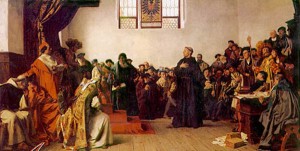
The following three excerpts are beautiful gospel truths that were revealed to Martin Luther through the grace of Jesus Christ. They not only ended up rocking his theological universe, but also the rest of the world around 1500 AD. They are recorded in a wonderful historical and gospel-centered introduction to the Reformation in the book titled The Unquenchable Flame: Discovering the Heart of the Reformation by Michael Reeves...
"For some time, the answer eluded him. Then, in 1519, when he was looking again at the issues of confession and repentance, it struck him that, after the sinner had confessed, the priest would pronounce God's promise of forgiveness. It was a whole new way of looking at things for Luther: now, the question was, would the sinner trust God's promise? And with that, everything changed. Now he saw that forgiveness is not dependent on how certain the sinner is that he has been truly contrite; forgiveness comes simply be receiving the promise of God. Thus the sinner's hope is found, not in himself, but outside himself, in God's word of promise."
"Luther saw that the sinner, on accepting Christ's promise in the gospel, is simultaneously a sinner at heart and righteous by status. What has happened is the 'joyful exchange' in which all that she has (her sin) she gives to him, and all that he has (his righteousness, blessedness, life and glory) he gives to her. Thus she can confidently display 'her sins in the face of death and hell and say, "If I have sinned, yet my Christ, in whom I believe, has not sinned, and all his is mine and all mine is his".'"
"Faith, thought Luther, is not some inner resource we must summon up; if it were, it would by his definition be sin! For him, the question 'Have I got enough faith?' completely misunderstands what faith is, by looking to and so relying on itself, rather than Christ. Faith is a passive thing, simply accepting, receiving, believing Christ - taking God seriously in what he promises in the gospel."
Subscribe to:
Posts (Atom)